

← All products07 / 07
Rekindo
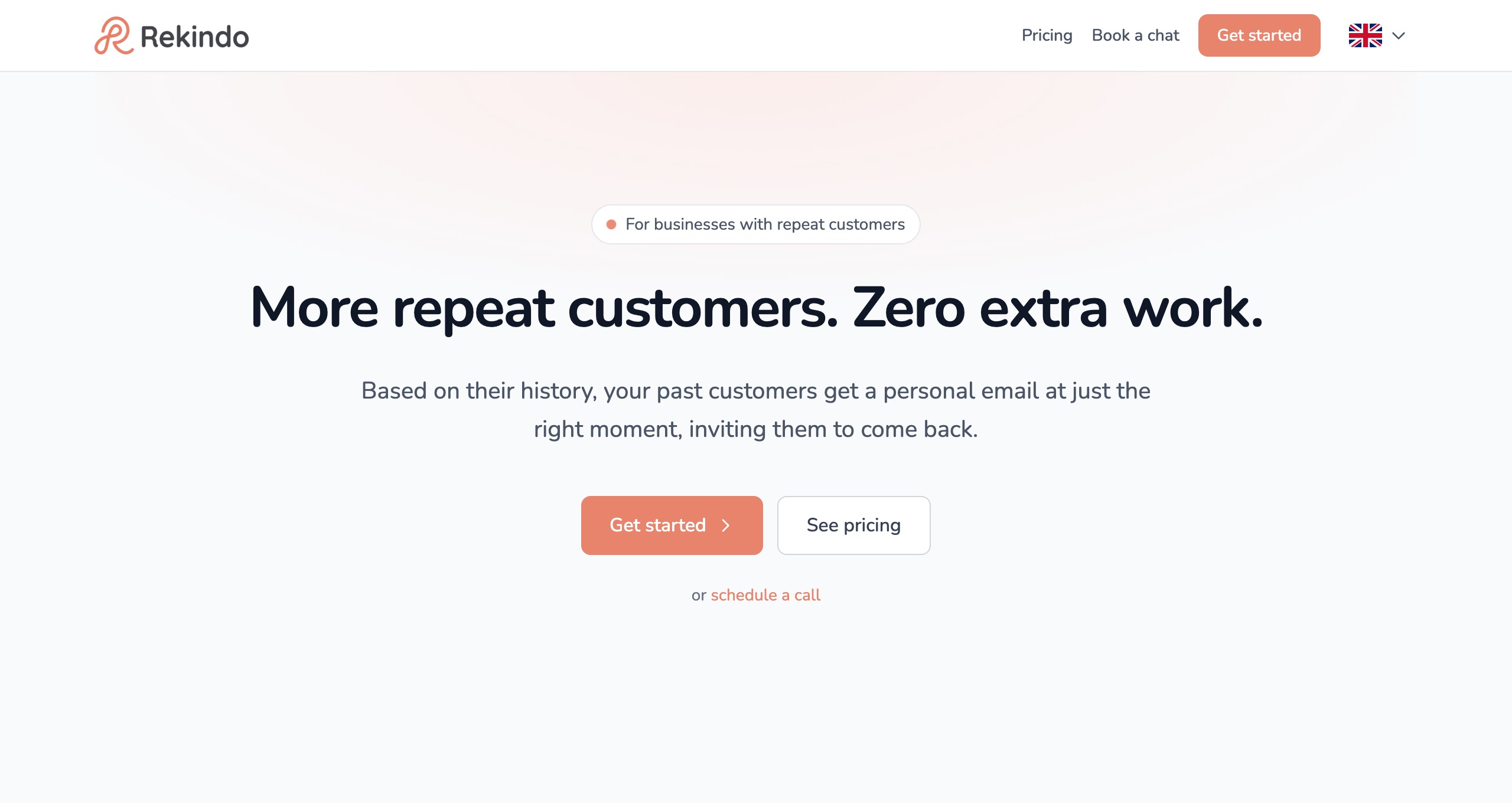
AI after-sales emails at the right moment.
Role
Founder, sole engineerJan – Oct 2026
Status
Built to launch, taken offline in 2026
In numbers
1,200 commits · 4 months · 6 languages · 3 integrations · 71 prompt scenarios
Hosted on
Self-managed Kubernetes on Hetzner
Stack
Django 6HTMXCeleryRedisPostgreSQL 17LiteLLMGemini 2.5 FlashAWS SES · SNS · SQS · LambdaKubernetes
The problem
Businesses with repeat customers, from salons to garages, lose people who simply forget to come back. Nobody has time to write the "it's been a while" email.
What I built
Booking and order systems send visit events. Rekindo learns each customer's rhythm, notices who is overdue, and drafts a personal email from their history. A person approves, or it sends itself.
Outcome
Idea to a product ready for paying customers in four months, with billing, six languages, and Zapier, Lightspeed and Calendly integrations.
An LLM is only as good as the context you hand it. Most of the work was the data model around the customer, not the prompt.what I took from it
How it works
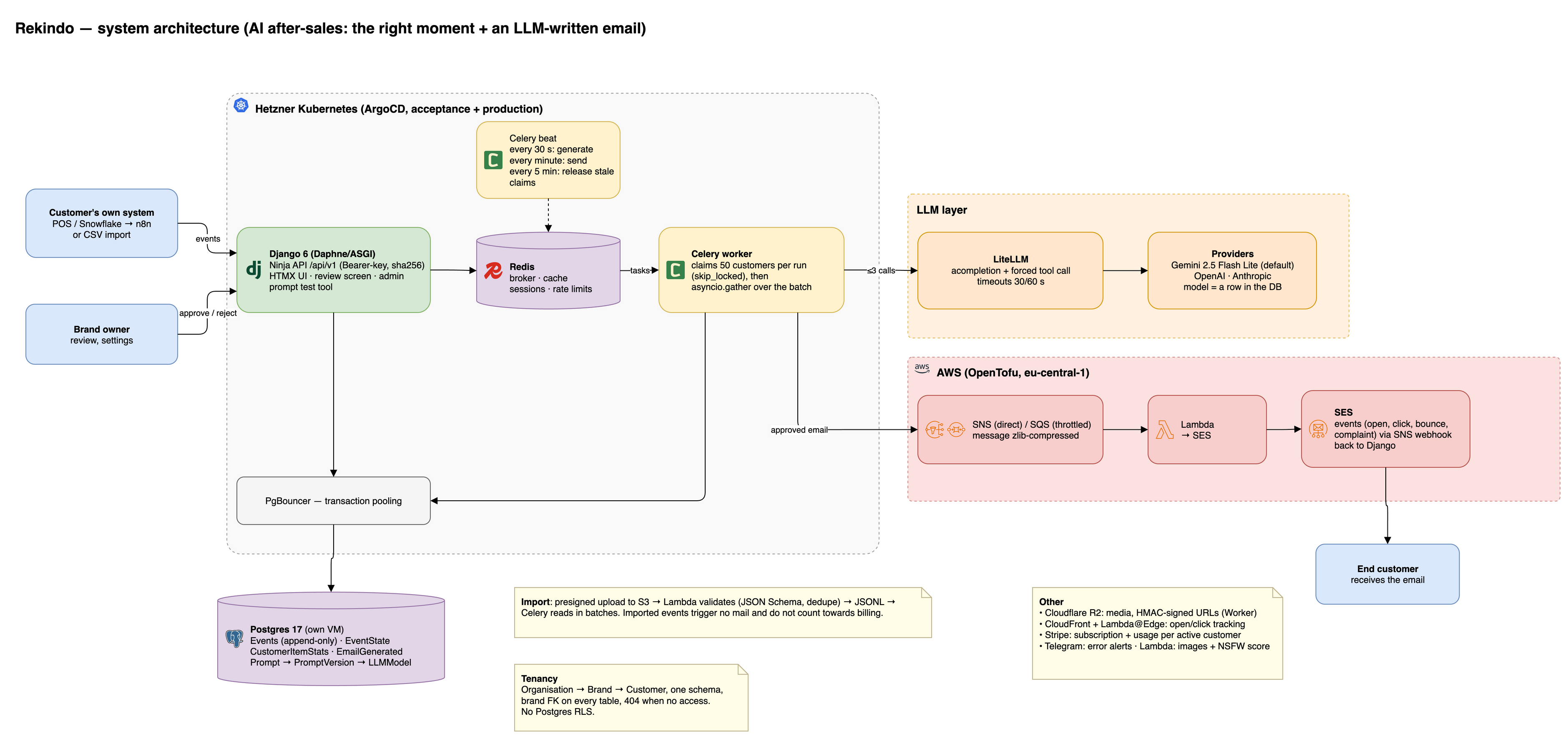
Rekindo system architecture. Click to open full size
Working with the model
- Every call to the model is a forced tool call. The JSON schema is built per customer, so the services they actually had become the enum values, and the answer can only come back in the shape the code expects. Structured output without a parsing step.
- Three stages per customer, each with its own prompt pair, temperature and model: estimate the rebooking interval per item, pick what is worth mentioning, write the email. A prompt version bundles all three, so a change is one row, not a deploy.
- A prompt workbench next to the app: scenarios for the awkward cases (first visit, no-show, appointment tomorrow, clicked but never booked, dormant for two years), versioned prompts, a debug API and a CLI. Claude ran the scenarios, judged every answer against the expected behaviour and flagged the contradictions, such as two timing rules fighting each other on five-year cycles.
- In production the versions compete. Each draft picks a random active version, opens and clicks are counted per version, and the prompt with the better numbers stays.
- Every call records tokens and cost. The model registry holds the price per million tokens and is validated against LiteLLM on save, so the cost of an email is a number in the UI, not a guess.
- Failures are sorted by kind: rate limit, auth, unknown model, empty response, unparsable arguments. Retries count up, and a person approves before anything goes out, unless a brand opts into auto-send.
Decisions
- Integrations are plain events over an API. Anything that can say "customer X visited today" plugs in the same way, whether it is a booking tool, a webshop or a Zapier zap.
- Three Celery loops: draft every 30 s, send every minute, release stale claims every 5 min. Workers claim 50 customers at a time and fan the LLM calls out with asyncio, so one slow model call never blocks the queue.
- Outbound mail through SES with an edge function for open and click tracking. Inbound mail and SES events come back through SNS webhooks, so a reply lands on the right customer's timeline.
- The model is a row in the database, chosen per brand behind LiteLLM. Switching providers is a setting, not a deploy.
- One schema, a brand key on every table, and a 404 instead of a 403 when you are not allowed. Nothing leaks, not even the fact that a record exists.
- Brand logos and product images run through the pipeline built for Kazengo: S3, a Lambda for NSFW scoring and WebP, Cloudflare R2 behind a signing Worker. Reused as is.
Timeline
- Jan 2026Skeleton, brands, events API, customer matching
- FebOverdue detection, first drafts, review screen
- MarSending, replies, Stripe billing
- AprIntegrations, six languages, onboarding
- May – OctPolish, marketing site, launch
- Late 2026Taken offline